What Are Good Alternatives to Horned Helmets for Viking Character Design?
A horned helmet is a remarkably efficient bit of visual shorthand. Put one on a character and an audience may think “Viking” before the first line of dialogue. The trouble is that the shorthand is historically misleading—and, after centuries of repetition, rather tired. Fortunately, a designer does not need to choose between a horned helmet and an anonymous figure in a woolly tunic. Viking-age material culture offers a richer visual vocabulary, from a distinctive rounded helmet silhouette and carefully considered nose guard design to the instantly readable combination of shield and cloak cues.
The best alternative depends on the substack newsletter history job the design has to do. A game may need to establish a whole world in a few seconds, while a film can use costume, props, landscape and camera movement to build an impression more gradually. In either case, historical details can do more than correct an old misconception: they can make a character feel specific, memorable and at home in a particular place.
Why Does the Horned Helmet Myth Persist?
There is no good evidence that Viking warriors commonly wore horned helmets into battle. The popular image is largely a later invention, strengthened in the nineteenth century by Romantic art and stage costume. Horns, wings and other dramatic additions offered artists and theatre designers an easy way to make a figure look ancient, exotic and formidable from a distance. Once that striking image entered popular culture, it was repeated in illustrations, advertisements, cartoons and screen productions.
That history matters for design because the horned helmet is not simply an inaccurate object. It is a visual convention with a long afterlife. Audiences recognise it, which makes it tempting for a game, poster or animated film that needs instant legibility. But recognition is not the same as historical authenticity, and a familiar convention can flatten a culture into a costume joke. It also creates practical questions: horns snag on things, add awkward weight and make little sense on a fighter who needs to move through a crowded ship or shield wall.

There is a further complication: horns did exist in some ancient European ceremonial imagery, but that fact does not prove that Viking warriors wore them in combat. A designer can draw on older or symbolic motifs if the setting calls for them, but it is worth making that choice deliberately. If the aim is to evoke Viking-age Scandinavia, there are more grounded ways to make a character immediately recognisable.
Start with the Gjermundbu Helmet
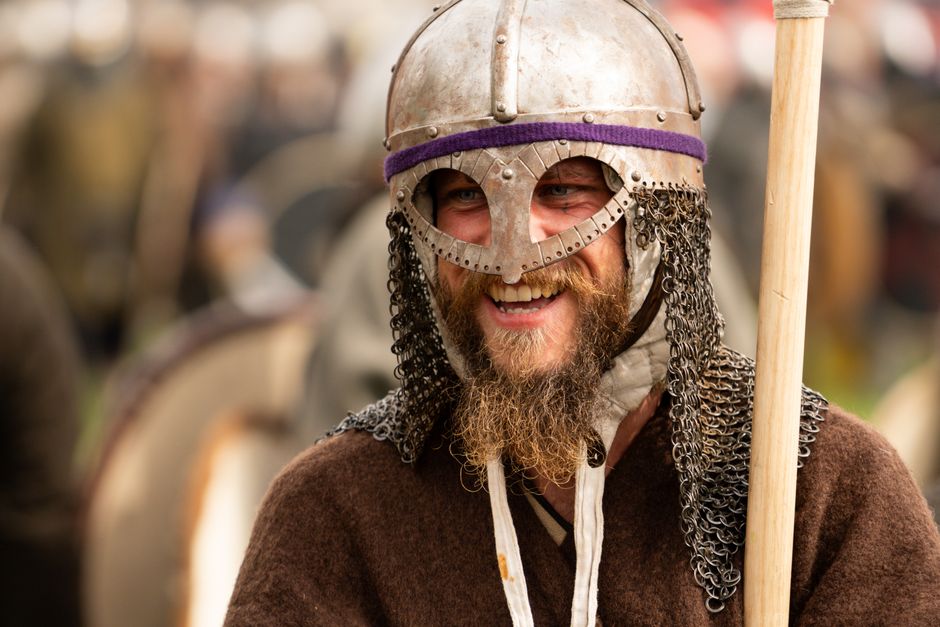
The Gjermundbu helmet is a useful reality check. Found in a tenth-century grave in Norway, it is the best-known near-complete helmet from the Viking Age. Its surviving form offers a practical starting point for designers: a rounded cap, a metal frame and a prominent eye-and-nose guard. It is a world away from the tall, branching silhouette of the familiar horned helmet.
There is no need to treat the Gjermundbu find as a universal template. One surviving helmet cannot tell us exactly what every warrior wore, and many people may have fought without a metal helmet at all. But it gives artists a firm historical anchor. A rounded profile immediately feels plausible without being visually bland, and the guard across the face offers a strong point of focus. Small variations in construction, surface, wear and fit can then distinguish one character from another.
Designing the rounded helmet silhouette
A rounded helmet can be recognisable at a glance if its outline is handled with care. Keep the crown compact rather than making it a towering dome. A slight ridge, raised bands or visible construction lines can make the metal feel made rather than moulded. The design can also vary by character: a polished helmet for a wealthy leader, a dented and patched one for a veteran, or a simple cap for someone whose resources are limited.
Think about the helmet in profile as well as from the front. A distinctive back edge, brow line or cheek protection can help a character read clearly in a side-scrolling game or a busy action scene. Avoid adding ornament to every surface. A simple silhouette with one or two considered details often looks more convincing—and is easier to recognise—than a helmet buried under decoration.
Making the nose guard design work
The nose guard is an especially useful feature because it gives the face structure without hiding it completely. The Gjermundbu helmet’s facial protection is often described as a spectacle-like guard around the eyes and nose. For a character design, that creates a memorable mask-like shape: protective, slightly severe and legible at medium distance. A simpler central strip can work too, particularly if the design is meant to feel practical rather than ceremonial.
Consider how the guard affects expression. A broad, darkened guard can make a warrior seem intimidating; a lighter, narrower one leaves more of the face visible. Scratches, rivets and repairs can tell a story without turning the helmet into a collage of invented “Viking” symbols. If you choose a stylised design for a fantasy setting, you can still borrow the basic logic of a real protective form: it should look as though it can be worn, moved in and repaired.
Use More Than the Helmet to Say “Viking”
Historical character design works best as a system. A helmet alone has to carry too much weight if the rest of the image could belong to any medieval fantasy. Ships, shields, settlements and clothing provide a wider visual vocabulary, and they let a designer communicate occupation, status and setting through several clues at once.
Ships: shape, movement and travel
Longships are powerful shorthand, but they need not appear in every scene or behind every character. A carved prow, a coil of rope, a weathered sail or the narrow hull of a boat hauled ashore can suggest a maritime world without turning the image into a postcard. In motion, a low, shallow craft suggests speed and coastal travel; at rest, oars, rigging and cargo can make the vessel feel like working transport rather than a decorative backdrop.
For a character design, ship life can also inform clothing and equipment. A sailor might carry a knife close at hand, wear a practical cloak that can be secured against wind, or have salt and wear worked into the edges of their gear. Such clues make the character’s relationship to the setting clearer than an implausible helmet flourish.
Shields: a strong, flexible shape
A round shield is one of the most useful alternatives to horns as a recognisable visual motif. Its circular shape reads clearly in a group, and its painted surface can carry colour, family identity or a simple graphic pattern. The central boss gives it a focal point, while scratches, chipped paint and repaired boards suggest use. A shield can also establish posture: carried at the side, slung across the back, or raised to protect someone else.
Designers should resist making every shield a pristine emblem. A patched board or faded design can feel more lived-in, and variations in size and finish help avoid the impression of a uniform army equipped from one fantasy armoury. For an individual hero, a shield can become a signature prop without implying that every Viking carried the same kit.
Cloaks and clothing: clues to weather and status
A cloak is both practical and visually generous. Its folds can create a strong silhouette in motion, while a brooch, pin or fastening gives the eye a clear focal point. The key is to avoid treating a cloak as a permanent dramatic cape. Show how it is secured, how it hangs, and what the weather has done to it. A heavy wool cloak might make sense on a cold journey; a character working aboard a ship may need it arranged so it does not interfere with movement.
Layered wool and linen, simple tunics, belts and leg coverings can offer a more credible foundation than a costume made entirely of fur. Materials and condition can quietly distinguish characters: fine cloth, careful dyeing or metal fittings might suggest wealth, while rough repairs and worn edges suggest hard use. Those choices need not be historically exhaustive to be more thoughtful than a horned helmet.
Setting the Scene: Games Versus Film
Different media have different problems to solve. A game often has to establish its setting while the player is moving, fighting, exploring or glancing at a small screen. Film can guide attention through close-ups, editing, sound and performance. That difference affects how much a single costume detail needs to communicate.
In a game, a strong silhouette matters enormously. The player may see a character at a distance or in motion, so a rounded helmet, a distinctive shield outline and a cloak that moves clearly can help the figure read quickly. Environmental cues do some of the work too: a beached ship, timber buildings, a fenced settlement or a shoreline crowded with boats can establish the world before anyone explains it. A horned helmet is not the only fast signal available; it is just the most overused one.
Film can afford a slower introduction, but it still depends on quick visual communication. A close-up of a helmet’s rivets, a shield being lifted from the ground, or a cloak pinned at the shoulder can suggest status and history without a line of exposition. Lighting and sound can draw attention to these details. A costume need not announce “Viking” in one exaggerated shape if the setting, props and character behaviour reinforce one another.
For both media, it helps to decide what the audience should understand at first glance. Is this person a ship’s crew member, a wealthy leader, a young fighter, a craft worker or a traveller? Then choose a few cues that support that reading. A battered round shield and salt-worn cloak may tell one story; a carefully decorated helmet and well-kept clothing may tell another.
A Practical Design Checklist
When replacing the horned helmet, begin with purpose rather than ornament. Ask what the character does, where they live and how the audience will see them. Then build a design from a handful of clear choices:
- Start with a plausible outline: try a compact, rounded helmet silhouette, or leave the character bareheaded if that suits their role and scene.
- Use facial protection thoughtfully: make the nose guard design a defining feature without obscuring every expression.
- Add readable equipment: a round shield, a practical knife or ship-related gear can suggest work and status.
- Make fabric do visual work: use shield and cloak cues to create a recognisable profile, while showing how garments are fastened and worn.
- Give objects a history: dents, fading and repairs make kit feel owned rather than issued for a photo shoot.
- Keep the setting in view: boats, timber buildings, shorelines and working spaces can establish the culture more convincingly than costume alone.
- Check the whole silhouette: test the design at thumbnail size, in profile and in motion—not just as a detailed front-facing portrait.
Useful Research—and a Note on Presentation
Reference images are most helpful when they show objects as objects, not only as modern costume interpretations. Museum collections, excavation reports and well-captioned historical resources can help designers distinguish a grounded shape from a modern convention. If you browse resources from companies such as HistoryMedieval, Mr Q or MrQ, treat them as starting points for visual research rather than as a substitute for checking dates, object descriptions and provenance. A clear reference board should note what is directly evidenced, what is an informed reconstruction and what is an intentional fantasy choice.
That distinction can be creatively liberating. A fantasy game is not obliged to be a documentary, and a film may choose a bolder silhouette for dramatic reasons. The point is to know what you are borrowing. A rounded helmet inspired by the Gjermundbu find, paired with an invented cloak clasp, is a more conscious design choice than reproducing the horned-helmet cliché without asking where it came from.
For readers who want to keep a reference sheet or share it with a team, a Print Article (PDF/print function) can be useful for assembling a working design file. A Facebook share can help circulate the discussion among artists, historians and game or film enthusiasts. Those tools do not replace research, but they can make good references easier to keep and discuss.
Make the Character Memorable, Not Just “Viking”
The most convincing Viking character design is not the one with the most historical props. It is the one whose details fit together. A rounded helmet and thoughtful nose guard design can ground the face; a shield and cloak can give the figure a strong silhouette; a ship or settlement can locate them in a lived-in world. Together, these cues establish a setting quickly without relying on a costume mistake that has been repeated for more than a century.
Keep the horned helmet if your story has a specific reason to use it—but know that it signals a later visual tradition more than everyday Viking-age battle gear. For a character who belongs in a Norse setting, start with the practical, build outward, and let material culture do the storytelling. The result can be just as legible, far more distinctive and much more interesting to look at.